
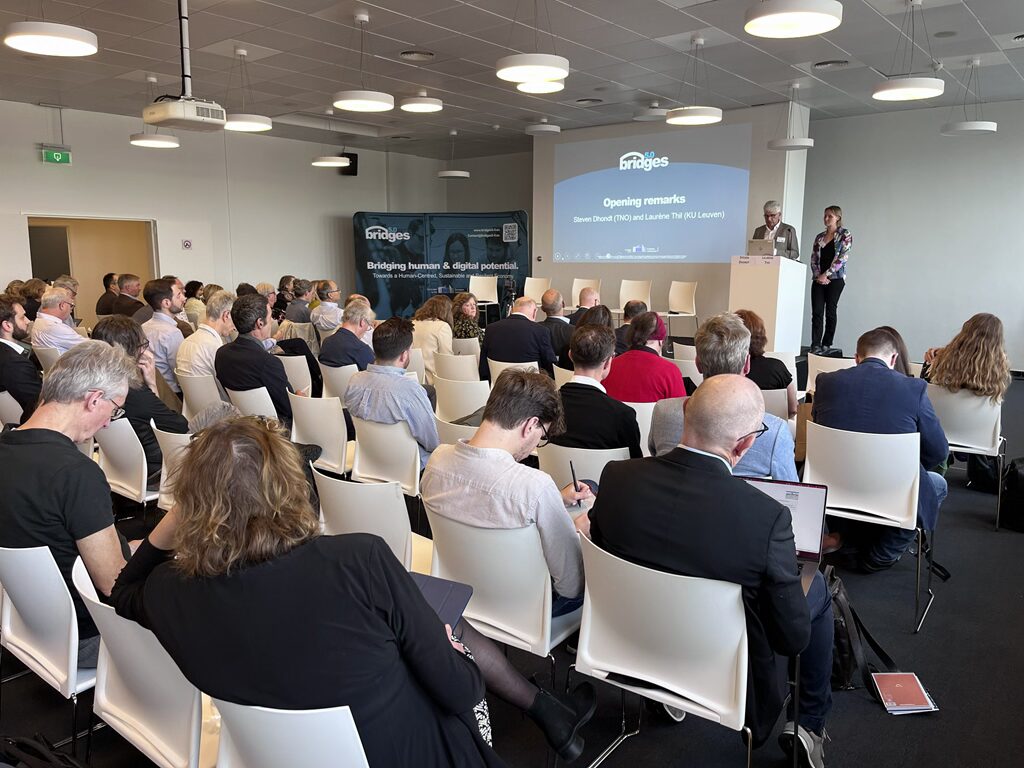
Summary of the BRIDGES–EUWIN webinar, 27 November 2026
Ten trends for 2040
The DLR work drew on desk research (World Economic Forum, OECD, ILO and European Commission reports, plus academic studies), an online expert survey, interviews with leading scholars, and an in-person workshop with 27 participants from 14 countries. Experts from 29 European countries contributed in total. A futures-wheel exercise, which asks what follows from each trend and then what follows from that, produced ten prioritised trends in four clusters.
- AI and automation. Experts kept returning to the question of who decides. If an algorithm rejects a job application, can the applicant find out why? They called for a right to challenge AI decisions and for workers to have a say in how AI is used, and warned that dependence on a few large technology providers gives vendors growing influence over working conditions. On automation, the World Economic Forum expects 69 million new roles and 83 million lost roles by 2027, which looks almost balanced. The detail matters more: automation mostly takes over tasks rather than whole jobs, so a job title may survive while half of what the person does changes. Higher-skilled workers tend to gain flexibility, while lower-paid jobs face more monitoring. A claims handler, for example, may increasingly review and sometimes overrule an AI-drafted decision, which demands both understanding of the system and the confidence to say it is wrong.
- Skills and lifelong learning. The World Economic Forum expects 39% of workers’ current skills to change significantly or become outdated by 2030. The experts warned that learning often becomes a private matter, done in the evening after work and family time. People with good skills and supportive employers receive more training, those in insecure jobs receive less, and employers tend to fund short, job-specific courses over broader development. Without intervention, lifelong learning could widen existing gaps.
- Workforce and economy. An ageing population means fewer and later labour-market entrants. In the EU, employment among those aged 55 to 64 rose from about 50% in 2014 to 65.5% in 2024, but not enough to close the gap. Experts expect project delays caused by staff shortages, more training for older workers, and a larger, politically heated role for immigration. At the same time, economic pressure is pulling the other way: half of employers surveyed by the World Economic Forum expect the rising cost of living to change their business model, and experts anticipate more algorithmic management, with small firms and social economy organisations hit hardest. Employers need more people while cost pressure encourages them to treat people as a cost to cut, and how organisations resolve that tension will shape working conditions for years.
- New work models and expectations. Flexibility often shifts responsibility to the individual, including the responsibility to avoid burnout. Gig work brings questions about sick pay and pensions, and experts expect labour law to come under pressure; the longer people do gig work, the harder it is to return to regular employment. The World Economic Forum finds that 73% of employees want permanent flexible working options, but autonomy is unevenly distributed: a software developer can work from almost anywhere, a nurse or bus driver cannot. That risks dividing the labour market further.
These trends were then used to describe a best-case vision for Europe in 2040, in which AI supports workers under clear rules, everyone has access to learning, flexible work comes with social security, and competitiveness is balanced with social goals. A backcasting workshop in Bonn in January 2026, with around 40 experts, worked backwards from that vision to ask what must be in place by 2035, by 2030 and what must start now. The results will feed into the research priorities of a planned European partnership on social transformations and resilience, due to start in 2027.
Looking back to look forward: scenarios to 2100
Claudio Zettel’s project began by looking backwards. His team read dozens of foresight studies from the 1950s onwards and found that their forecasts were generally accurate about what would happen but too optimistic about when, sometimes by decades. Science fiction shows the same pattern: the years in which films such as Back to the Future or Running Man were set have already passed. The older studies also badly underestimated globalisation and non-state, non-military disruptions, and said almost nothing about social innovation, because innovation was always equated with hard technology.
To look forward, the team combined scenario techniques with workshops that brought together labour and foresight experts and science fiction authors, to imagine wild-card disruptions that break from linear development. (Their facilitation tip: start with a bottle of wine, because it makes it easier to think like a science fiction author.) The result is five scenarios:
- Race to the bottom, where everything is subordinated to money
- Automation, where humans are displaced by AI and work moves to places machines cannot go, such as the deep sea and outer space, under forced labour and extreme performance control
- Craftsman, a return to roots and a retreat from technology
- AI technocracy, where AI takes over decision-making
- Post-growth society, the only utopian scenario, in which money plays no role because everyone has what they need
Each scenario is defined by a handful of core descriptors, including the division of work, work environment, commodification, work organisation and performance control. To make the dystopias tangible, Claudio pointed to science fiction that already explores them, among them the novel QualityLand, the TV series The Expanse, the film I, Robot and the thriller The Circle, whose vision of radical openness and total connectivity, he suggested, looks less like fiction each year. Nearly 100 short stories about the future of work were written by authors using the descriptors, and the ten best have been published in a book.
The scenarios are not predictions or recommendations. They are tools for stakeholders, including social partners and policymakers, to identify the decision points where society could tip towards one future or another, and to examine how stable the current balance between governments, social partners, employers and workers really is.
Discussion
The system behind the trends. Frank Pot asked how work on trends can take account of the wider socioeconomic and power system in which they unfold, voicing concern about pressures on collective representation in Europe, with recent works council elections in Germany as an example. Claudio shared the concern, explaining that the scenario approach aims to push stakeholders such as social partners to think beyond how they have operated for the past decades. Simon’s trend work is more directly predictive, while Claudio’s is deliberately exploratory.
Regional and institutional variety. Makó Csaba welcomed the presentations and urged attention to differences between regions and sectors, and to the institutional variety within the EU. He noted, for instance, the strong contrast between Nordic and Central European understandings of stakeholder roles, and recommended Daron Acemoglu and Simon Johnson’s book Power and Progress: Our Thousand-Year Struggle Over Technology and Prosperity. Claudio clarified that the scenarios were designed around the German context and institutions, and that other systems, in Europe, Asia and the US, differ greatly. Peter Totterdill added a question about whether these futures contain levers for a distinctively positive European path.
New work from structural change. Hans Christian Garmann Johnsen observed that thinkers from Adam Smith to Marx anticipated industrial change while missing its social consequences. He suggested that rebuilding the structures we take for granted, as we once built industrial towns and now rework them, will itself create entirely new kinds of work. Claudio agreed that new jobs will emerge, though many may be hard to imagine today.
Who drives innovation? Peter asked how innovation happens in atomised futures where people no longer meet informally. Claudio argued that in the three AI-dominated dystopias innovation would effectively stop, becoming a closed shop with no one thinking outside the box. Human creativity is irreplaceable, and the answer is to keep humans in the loop.
The recording and presentation are available at https://bridges5-0.eu/recordings/
Related articles
November 29, 2026
November 24, 2026

October 11, 2026
September 28, 2026
September 20, 2026