

Steven Dhondt
TNO, Bridges 5.0 Co-ordinator
The summer seems to be a period in which not a lot happens in projects. However, there is more activity than meets the eye.
Bridges 5.0 is coming to the results phase as the project teams work diligently on their research. In the past months, our UK team has delivered the results of big data analyses and, during the summer, our Greek and Spanish teams finalised their Teaching and Learning Factory research.
Five companies participated in developing Teaching Factory 5.0. Each of the companies has shown what is needed to become such a Teaching Factory. Experiments varied from designing new operator work stations to redesigning robotic repair situations. In each of the cases, the research teams guided the participants to guide processes and participants towards Industry 5.0 thinking.
In addition to work with the five companies, Learning Factory 5.0 has also been developed. More than five networks of schools and companies have collaborated to adapt the Learning Factory methodology to Industry 5.0 requirements.
Our teams will present these exciting outcomes at our Patras Workshop on 23rd October. All our companies and networks come together to celebrate this special occasion, and the results will be reported fully in our next Newsletter.
The Teaching/Learning Factory work is particularly important for Bridges 5.0. When companies want to adapt to Industry 5.0, having a methodology to make the changeover can be an important means of support. It helps speed up change processes for companies, but more importantly, it reduces what are called ‘mandate costs’, in other words the financial and resource costs incurred during the journey to Industry 5.0. Without practical guidance, companies spend a lot of investment trying to find out how to reach the goal. The results of Bridges 5.0 help lower these ‘mandate costs’.
In the coming months, the Bridges 5.0 teams will be building on these important results. A policy workshop will be organised in January 2026 to translate the results into policy-relevant guidance. The teams have already started to write up the project lessons in a practical handbook for companies and practitioners.
Our research results on the importance of Industry 5.0 will also be delivered by the end of 2025. As you can see, the Bridges 5.0 summer has been a period bubbling with activity. We will be proud to share our results.
About Teaching and Learning Factories
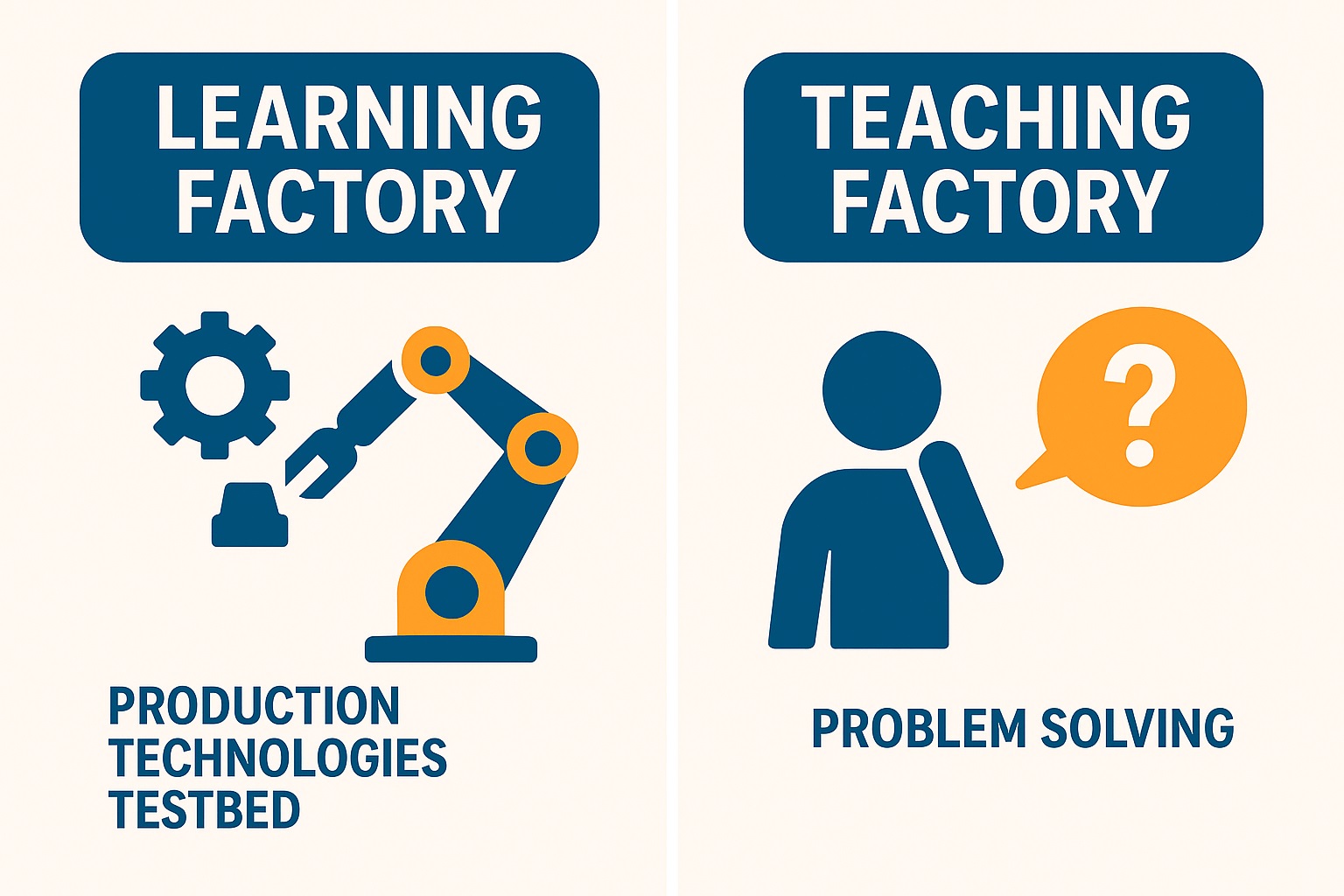
Teaching Factories (TFs) are defined as collaborative learning environments where practitioners from industry share their expertise with students, while students and academic staff bring theoretical knowledge into the workplace setting. This reciprocal exchange is structured as a continuous learning process, characterised by regular interaction and mutual problem-solving. The central pedagogical emphasis of TFs is on problem-solving, critical thinking, and innovation in real-time industrial contexts.
Learning Factories (LFs), by contrast, are controlled learning environments that simulate industrial settings. These spaces use actual tools, machinery, and workflows that mirror real factories, enabling participants to engage in hands-on learning of industrial techniques and concepts (Abele et al., 2017). The core focus of LFs lies in innovation management and the acquisition of technical competencies through immersive, practice-based learning.
Related articles

February 28, 2026
February 25, 2026
February 25, 2026