

Peter Totterdill
Workplace Innovation Europe Ireland

Steven Dhondt
TNO, Bridges 5.0 Co-ordinator
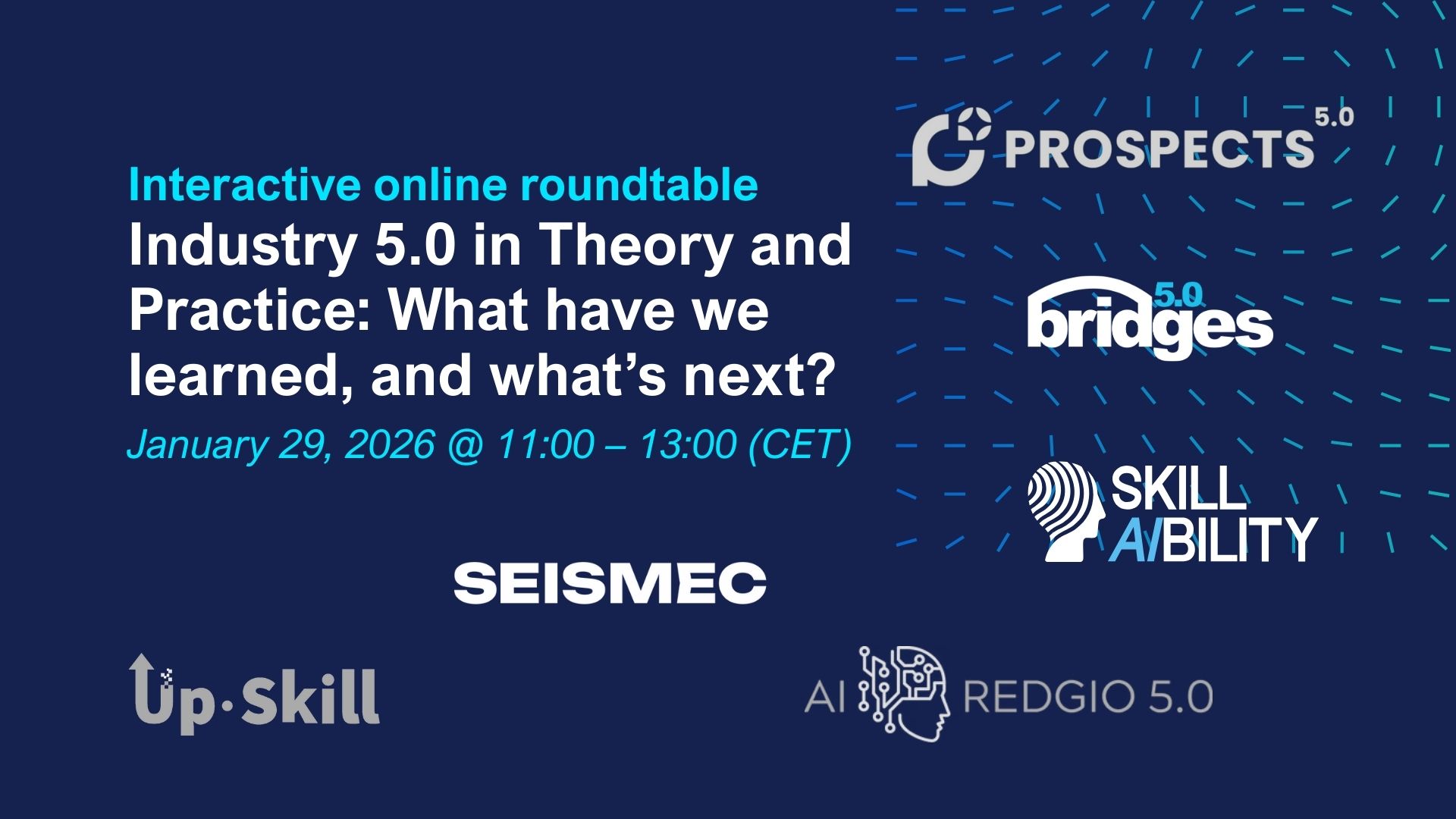
Industry 5.0 in Theory and Practice: Insights from a Cross Project Dialogue – 29th January 2026
When Six EU Projects Walk Into a Room: The Unexpected Story of Industry 5.0
What can you expect if you bring six European projects together to discuss their lessons on the subject of Industry 5.0? Perhaps a clash of perspectives. Perhaps polite disagreement. Perhaps a battle for attention? Perhaps nothing more than another academic exercise. Yet when researchers and practitioners from Horizon projects Bridges 5.0, Prospects 5.0, SkillAIbility, Seismec, AIREDGIO, and Upskill gathered for the Industry 5.0 in Theory and Practice webinar, something unexpected happened. Instead of fragmentation, a story began to emerge — a story of urgency, of shared challenges, and of a surprising convergence that none of the projects had fully anticipated on their own.
A Turning Point, Not a Next Step
The conversation opened with a deceptively simple question: What actually makes Industry 5.0 different? As speakers compared notes, it became clear that Industry 5.0 is not the “upgrade pack” to Industry 4.0 that many assume. Nor is it a shiny rebrand glued onto old ideas. It is, instead, a response — almost a collective exhale — to years of acceleration, automation, and uncertainty. Companies are still struggling with Industry 4.0 adoption; workers are wrestling with the pace of change; societies are questioning the human cost of technological transformation. Industry 5.0 steps into that tension not with more technology, but with a counterweight: responsibility, agency, resilience, sustainability. And the surprise? Across countries, sectors, and projects, people seemed to be grappling with exactly the same problems.
Everyone agreed on one point: human-centricity lies at the heart of Industry 5.0. But the discussion quickly revealed that agreeing on human-centricity and achieving it are two different stories. Some workers don’t want autonomy; others don’t trust it. Some organisations talk about empowerment but cling tightly to hierarchy. Tools like ergonomics, participatory design, and sociotechnical methods already exist — but adoption is spotty at best. And then came the shared worry: What if humancentricity becomes a checkbox? A slogan? A siloed workstream? If that happens, Industry 5.0 risks becoming precisely what it was designed to challenge.
The Workforce Gap: A Story of Complexity, Not Deficit
As projects described their work with companies, a new storyline emerged — one that cut across national and sectoral boundaries. “Generational divides are widening. Demographic pressures are mounting.”, “Multicultural teams bring incredible value — and real communication challenges.”, “Skills gaps stretch far beyond digital literacy to include collaboration, curiosity, systems thinking.” But the most powerful insight was almost deceptively simple: co-design actually works. Whenever companies involved workers not at the end of the process but from the beginning — through shared experiments, teaching factories, participatory tools — the outcomes were better. Always. This was not a theoretical claim. It was an empirical fact emerging independently across projects.
One story stood out: a digital production-board system introduced to support self-organisation ended up alienating workers. What was meant to empower them instead erased the craft-based identity many valued. Others shared similar examples. Technology reorganises work, identity, skills, and relationships — whether or not organisations are prepared for those changes. But when technology was introduced with workers, not to them, something shifted: adoption improved, resistance softened, resilience strengthened. The lesson became unmistakable:
Human-centricity isn’t a feature of technology. It is a feature of design, of organising the work.
Policy vs. Practice: What Companies Actually Need on Monday Morning
As the dialogue moved to policy, another theme emerged: Industry 5.0 may be spearheaded at the European level, but its success will depend on regional realities and institutional courage. Projects voiced concerns about duplicated tools, fragmented support, and the limited capacity of unions and worker representation to engage with AI and algorithmic management. Yet they also emphasised that many regions will continue pushing industry transformation regardless of shifting EU priorities — because labour shortages, environmental pressures, and industrial restructuring are not going away. Industry 5.0, they agreed, is not a project. It is a trajectory.
By the end of the webinar, a consensus emerged that felt remarkably grounded. Companies don’t need more concepts. They need clarity. They need usable tools. They need support for cultural and organisational change, not just technological adoption. They need proof-of-practice examples and participatory learning models that are easy to scale. And SMEs need accessible financial and advisory support if Industry 5.0 is to become more than an aspiration. In short, they need a roadmap — not a manifesto.
A Surprising Alignment — and a Path Forward: Industry 5.0 as a Direction, Not a Destination
Perhaps the most striking outcome of the entire session was the call for shared infrastructure: a jointly owned Industry 5.0 Platform, evolving from Fresh Thinking Labs, to gather the tools, insights, and lessons scattered across dozens of projects. The idea wasn’t met with polite nodding. It sparked genuine energy — a recognition that without shared space, these hard-won insights risk evaporating at the end of each funding cycle. A platform could turn scattered projects into a community. It could turn lessons into leverage. And it could turn Industry 5.0 from a promising concept into a living, evolving practice.
By the time the webinar ended, one thing had become clear: Industry 5.0 is not neatly defined, and perhaps it shouldn’t be. It is alive, debated, and shaped by real organisational pressures. But its core themes resonate widely: Human-centricity must be lived, not declared. Technology must serve people. Change must be co-created. Policy must align with culture. Collaboration is not optional — it is the only way forward. Industry 5.0 is not where we arrive. It is the direction we choose.
We need more such discussions!
We wish to thank our panel of expert speakers:
Roland Sommer, BRIDGES 5.0
Ziga Valic, PROSPECTS 5.0
Siobhán O’Neill, SEISMEC
Simona Aceto, PROSPECTS 5.0
Sullivan Brendan, SKILLAIBILITY
Diane Confurius, SEISMEC
Chris Ivory, UPSKILL
Moderator – Peter Totterdill, WIE CLG
The recording can be found at https://bridges5-0.eu/recordings/
Related articles
February 28, 2026
February 25, 2026
February 25, 2026